
Relief funds are a financial lifeline for businesses in crisis. They help cover urgent costs like payroll, rent, and utilities, offering a chance to recover when other funding options are unavailable. Without these funds, businesses face mounting debts, operational challenges, and potential closure.
Here’s what you need to know:
- What they are: Relief funds are grants or low-interest loans designed for emergencies, unlike traditional loans requiring collateral or lengthy approvals.
- Why they matter: They stabilize businesses during crises, preventing layoffs and closures. For example, programs like the Paycheck Protection Program (PPP) saved countless jobs during COVID-19.
- Challenges without them: Companies without relief funds struggle with cash flow, debt, and employee retention, often leading to bankruptcy.
- How to use them: Prioritize critical expenses like payroll and rent, then invest in areas that support recovery.
- Beyond funding: Platforms like Urgent Exits connect distressed businesses with buyers, creating opportunities for long-term recovery or transitions.
Relief funds are just the start. Using them wisely and exploring additional solutions like business marketplaces can make the difference between recovery and permanent closure.
Announcement of Connecticut CARES Small Business Grant Program
Problems Distressed Businesses Face Without Relief Funds
Distressed businesses without access to emergency funding often find themselves grappling with immediate operational crises and long-term financial instability. These challenges can quickly spiral out of control, jeopardizing the very survival of the company. The need for quick access to relief funds becomes critical to halt this downward trend.
Financial Pressure and Operational Challenges
Cash flow issues hit hard when businesses lack relief funds. Most small businesses only have enough reserves to last about two months, so any prolonged financial strain can rapidly drain their safety net. On top of that, creditors often intensify their demands, which can lead to legal actions, asset seizures, or even liquidation.
Supply chain disruptions make matters worse. Without financial reserves, companies can’t absorb the costs of delayed shipments, rising prices, or losing key suppliers. This often results in inventory shortages and an inability to meet customer demands. During disasters, for example, 27% of affected businesses had to relocate just to survive these operational setbacks.
Unexpected expenses, like equipment breakdowns or emergency repairs, add another layer of difficulty. Without the necessary funds to address these issues, businesses may see a decline in service quality, lose customers, and suffer further revenue losses.
The Challenges of Securing Traditional Loans
When internal cash reserves run dry, businesses often look to external financing. However, traditional loans are notoriously difficult for struggling companies to secure. Lenders typically require strong credit scores and valuable collateral – two things distressed businesses often lack. The loan application process is another hurdle, with its extensive paperwork, long approval times, and strict qualification criteria. Even if approved, businesses frequently face unfavorable terms, like high interest rates and restrictive covenants, which limit their flexibility during recovery.
Because of these barriers, 56% of businesses affected by disasters don’t rely on external funding and instead absorb losses internally. Among those that do secure outside help, only 18% access federal disaster relief programs, while 31% take on debt or loans – often under terms that worsen their financial strain. These funding challenges only add to the stress and instability across the business.
Impact on Employees and Workplace Morale
The lack of relief funding doesn’t just affect operations – it also takes a toll on employees. Companies facing severe financial distress often resort to layoffs, reduced hours, or wage cuts. These measures create uncertainty and can lead to high employee turnover, as workers leave for more stable opportunities. Losing experienced staff makes recovery even harder.
For those who stay, morale often plummets. Concerns about job security and the company’s future weigh heavily, reducing productivity and engagement. Delayed paychecks and slashed benefits add to the frustration, sometimes pushing employees to look for other jobs. This exodus of talent further destabilizes the business, making it even tougher to bounce back.
Types of Relief Funds for Distressed Businesses
When financial struggles arise, businesses have several funding options to consider. Knowing the different types of relief programs available can help you secure the right funding quickly, tailored to your specific needs.
Government Programs and Policies
Federal relief programs are often the cornerstone of disaster and economic recovery efforts for businesses. These programs provide substantial financial support but typically come with strict eligibility criteria and formal application procedures.
The Paycheck Protection Program (PPP) offers forgivable loans to small businesses with fewer than 500 employees. These loans are aimed at helping businesses maintain payroll and cover essential costs like rent and utilities. Similarly, the Employee Retention Credit (ERC) provides refundable tax credits for employers who retained their workforce during tough economic times, with eligibility determined by business size and the level of operational disruption.
For businesses impacted by natural disasters, the Economic Adjustment Assistance (EAA) program – managed by the Economic Development Administration – provides grants to regions hit by severe economic distress from events like hurricanes, wildfires, floods, or tornadoes. In fiscal year 2023, $587 million in supplemental appropriations were allocated to help communities recover from major disasters such as Hurricanes Ian and Fiona.
Applications for these federal programs are typically submitted through government portals or participating financial institutions. Agencies like the U.S. Treasury and the Economic Development Administration (EDA) offer guidance throughout the process.
Private Sector and Charity Programs
Private relief programs often offer quicker access to funds and greater flexibility, making them a valuable option for businesses that need immediate assistance or don’t qualify for federal programs.
Employer-sponsored disaster relief funds allow businesses to provide tax-free aid directly to their employees under Section 139 of the tax code. These funds can cover costs such as medical expenses, childcare due to school closures, or expenses tied to setting up remote work arrangements.
Many employers partner with third-party charities, such as 501(c)(3) organizations, to manage these relief funds. This arrangement preserves tax benefits, as employer contributions remain deductible as regular business expenses.
Nonprofit foundations and community organizations also step in to help businesses in need. They may offer grants or low-interest loans based on demonstrated need, without the rigid regulatory requirements of federal programs. For example, a business could work with a local community foundation to establish a fund for disaster-affected companies, with the foundation handling the administration and distribution of resources.
To access these private programs, businesses typically submit a formal request for assistance, along with documentation of their needs. Applications are reviewed by an independent committee, often in coordination with the company’s human resources department or directly with the sponsoring organization.
Relief Fund Options Compared
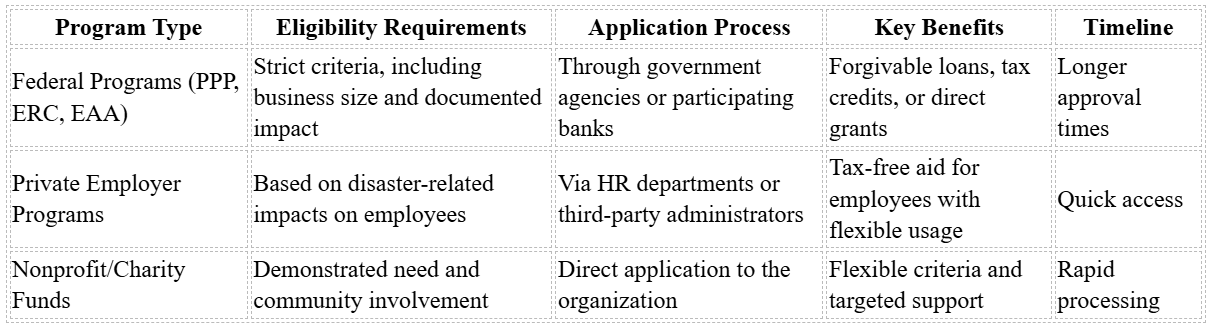
Interestingly, among businesses affected by disasters, only 11% secure federal disaster relief funds, while 12% turn to private loans, and 18% rely on insurance payouts. Many businesses combine multiple funding sources to address different recovery needs effectively.
How to Use Relief Funds Effectively
Securing relief funds is just the first step. The real challenge lies in using them wisely to turn short-term assistance into long-term recovery. A thoughtful approach to allocation and planning can make all the difference between temporary aid and sustainable progress.
How to Apply for Relief Funds
Applying for relief funds requires careful preparation. Start by researching programs that align with your needs – whether they’re federal, state, or local – and ensure you meet the eligibility requirements before proceeding.
Documentation is a key part of the process. Most programs will ask for financial statements, tax returns, payroll records, and a detailed explanation of how you plan to use the funds. Be clear in your application about how the money will address approved expenses like payroll, rent, or utilities. Many businesses find it helpful to work with consulting firms during this stage. These professionals can guide you through preparing and submitting documentation while ensuring compliance with regulations.
Timing is another crucial factor. Applying early in your recovery can minimize downtime and demonstrate your business’s ability to bounce back. Waiting too long may make it harder to prove your viability, increasing the risk of permanent closure.
Each program has its own compliance rules, often requiring detailed reports and audits to track how funds are spent. For instance, businesses receiving CARES Act funding had to document expenses like payroll or rent to avoid penalties or repayment obligations.
Once your application is in, the focus shifts to spending the funds in a way that maximizes their impact.
Best Ways to Spend Relief Money
To get the most out of your relief funds, prioritize expenses that stabilize your business and lay the groundwork for recovery. Start with essentials like payroll to retain your workforce and maintain operational continuity. Next, cover critical costs such as rent, utilities, and necessary repairs. During the COVID-19 pandemic, many businesses used relief funds to keep employees on payroll, which helped preserve morale and institutional knowledge.
After addressing these immediate needs, consider how leftover funds can support growth. For example, you might invest in inventory or equipment that generates revenue. A restaurant, for instance, could use additional funds to enhance its takeout and delivery services while ensuring staff and rent are covered.
Avoid spending on non-essential items during this period. Every dollar should be directed toward stabilizing your business and positioning it for recovery. Data shows that 80% of disaster-affected businesses using external funding were able to cover at least some of their losses, while 20% saw no recovery despite receiving aid. The difference often lies in how funds are allocated.
Once your immediate expenses are under control, the next step is to create a plan for sustained recovery.
Creating a Recovery Plan
A well-thought-out recovery plan ensures that relief funds have a lasting impact. Start by identifying strategies to restructure operations, such as cutting unnecessary expenses, renegotiating supplier contracts, and exploring new revenue opportunities.
If you’ve taken out loans, develop a realistic repayment plan that aligns with your projected cash flow and revenue recovery timeline. Building a steady cash flow should be a top priority.
Monitor your progress monthly and be ready to adjust your plan as conditions change. Set clear milestones to track your recovery and consider the long-term effects of your decisions, particularly how loan repayments might influence your financial health.
The Economic Development Administration offers three pathways to guide your recovery efforts: Readiness for businesses in the planning phase, Implementation for those actively working on recovery projects, and Industry Transformation for companies focusing on long-term renewal. Identifying which stage your business is in can help shape your strategy.
Finally, consulting firms can provide valuable expertise throughout this process, helping you navigate compliance requirements and avoid common mistakes. Their guidance can be instrumental in ensuring your recovery efforts are both effective and sustainable.
How Online Marketplaces Help Distressed Businesses
Relief funds can provide essential short-term stability for struggling businesses, but many need more than just financial assistance to recover or transition effectively. Online marketplaces tailored to distressed business transactions have become a critical resource, offering solutions that go beyond traditional funding. These platforms open up new paths for recovery or strategic exits, complementing the financial relief efforts already in place.
For businesses that don’t receive sufficient funding, these specialized marketplaces offer a lifeline. They create opportunities for transitions that might otherwise be difficult or impossible through conventional methods.
How Urgent Exits Supports Business Transitions
Urgent Exits is a marketplace designed specifically for distressed or broker-rejected businesses. Unlike general business-for-sale platforms, it caters exclusively to companies facing financial or operational challenges, providing a streamlined way to connect sellers with buyers.
The platform simplifies what is often a complicated and drawn-out process. Business owners can list their companies within minutes using an easy-to-navigate interface, sharing key details about their situation. Sellers can also monitor buyer interest in real time through metrics like views and saves, giving them a clear sense of market engagement.
For buyers, Urgent Exits delivers access to dozens of new listings every day, creating a dynamic marketplace filled with undervalued opportunities. Its advanced filtering and search tools help buyers pinpoint businesses that match their investment goals or turnaround expertise. This ensures that distressed companies connect with buyers who not only understand their challenges but also see potential for growth.
Additionally, the platform acts as a hub for professional advisors – such as appraisers, consultants, lawyers, and auctioneers – who can offer critical services like legal restructuring, financial analysis, and operational guidance. This network of experts helps facilitate smoother and faster business transitions.
Why Specialized Marketplaces Are Effective
While relief funds address immediate financial needs, platforms like Urgent Exits provide a sustainable way to manage business transitions. These marketplaces offer several key advantages over traditional business brokerage, especially for companies grappling with long-term challenges.
The most obvious benefits include speed and accessibility. Unlike traditional methods, which can drag on for months or even years, these platforms enable quick connections between motivated buyers and sellers. This speed can be the difference between a successful transition and permanent closure.
The platform’s focus on distressed assets attracts buyers who are specifically looking for undervalued businesses with turnaround potential. This targeted pool of buyers is more likely to understand the unique challenges of distressed companies, leading to realistic valuations and smoother negotiations. Furthermore, access to professional networks ensures that transitions are handled with expertise, whether through legal restructuring or exit planning.
For businesses that have received relief funding but still face long-term struggles, platforms like Urgent Exits offer strategic alternatives. Relief funds might stabilize operations temporarily, but these marketplaces create opportunities for longer-term recovery or exit strategies. This dual approach allows businesses to maximize the resources available to them.
By enabling direct engagement between sellers, buyers, and advisors, these platforms reduce transaction costs and speed up decision-making. Sellers can connect directly with serious buyers and qualified professionals, while buyers gain access to detailed information and verified opportunities.
Interestingly, research shows that 80% of grant recipients reported that emergency relief helped maintain their productivity at work. However, for businesses needing more than financial aid, marketplaces like Urgent Exits bridge the gap. They provide practical solutions for business transitions, asset management, and strategic restructuring – offering a much-needed complement to traditional financial assistance programs.
Conclusion: Relief Funds as a Lifeline for Distressed Businesses
Relief funds serve as a critical lifeline for businesses in financial distress, offering the immediate cash flow necessary to stay afloat and begin the recovery process. As highlighted earlier, these funds make up a large share of external financial support for businesses impacted by disasters, especially small enterprises with limited reserves. While this initial boost provides stability, it’s just the starting point on the path to full recovery.
How businesses allocate relief funds can determine the trajectory of their recovery. Many focus on covering essential expenses like payroll, rent, and utilities while also investing in areas that improve their long-term competitiveness. Programs such as the Paycheck Protection Program (PPP) have shown their value in helping businesses weather crises.
However, for some companies, short-term financial aid isn’t enough. These businesses often require a more strategic approach to transition out of distress. Platforms like Urgent Exits offer tailored solutions by connecting struggling businesses with buyers who specialize in turning around undervalued opportunities. This creates a pathway for businesses to restructure, sell, or merge in a way that maximizes their potential.
By combining immediate relief funding with strategic transitions, businesses have multiple tools to aid recovery. Relief funds stabilize day-to-day operations, while platforms like Urgent Exits provide access to buyers, restructuring experts, and M&A professionals who can guide businesses toward long-term solutions.
Ultimately, businesses that use relief funds as a foundation for growth – not just survival – are more likely to emerge stronger. These companies often streamline operations, tighten financial controls, and develop more resilient business models. Through a mix of immediate financial support and well-planned transitions, businesses can secure their future, foster growth, and create value for all stakeholders involved.
FAQs
How do government and private relief programs differ in helping distressed businesses?
Government relief programs are designed to provide businesses with broad financial support during tough economic times or emergencies. This support often comes in the form of grants, low-interest loans, or tax deferrals. However, these programs typically come with strict eligibility requirements. For instance, businesses may need to demonstrate financial hardship or agree to specific conditions, like maintaining payroll levels, to qualify.
In contrast, private sector relief programs tend to offer more tailored solutions. These might include private loans, investment opportunities, or partnerships with platforms and advisors who specialize in operational or financial restructuring. While private programs are often faster to access, they can come at a higher cost. Businesses may need to share equity or other assets in exchange for the assistance provided.
Both government and private options can be essential in helping businesses recover from financial difficulties. Many companies find success by combining the two approaches to address their unique challenges effectively.
How can businesses use relief funds effectively to support recovery and long-term stability?
To make the most of relief funds, businesses should focus on covering essential expenses first. These include payroll, rent, utilities, and critical supplies – items that keep operations running smoothly and avoid unnecessary financial strain.
Equally important is crafting a solid financial recovery plan. Allocate funds to tackle pressing needs while reserving some for future initiatives, like marketing campaigns or upgrading operations. Seeking advice from financial advisors or accountants can help ensure funds are managed effectively and align with any regulatory guidelines.
Don’t forget about record-keeping. Maintain detailed records of every expense tied to the relief funds. This not only demonstrates accountability but also prepares you for audits or reporting requirements that may come with these programs.
How can platforms like Urgent Exits support businesses that have used relief funds to stabilize?
Platforms like Urgent Exits serve as a lifeline for struggling businesses looking to move forward after using relief funds. They offer a straightforward marketplace where sellers can list businesses they need to exit quickly, while buyers can explore potential investment opportunities in undervalued ventures.
Beyond the marketplace, Urgent Exits links business owners with seasoned professionals, including consultants, accountants, and legal experts. These advisors help guide owners through complex processes like restructuring or liquidation, ensuring a smoother recovery or transition to new ownership.